


 Duncan Made
Shop towel roll holder
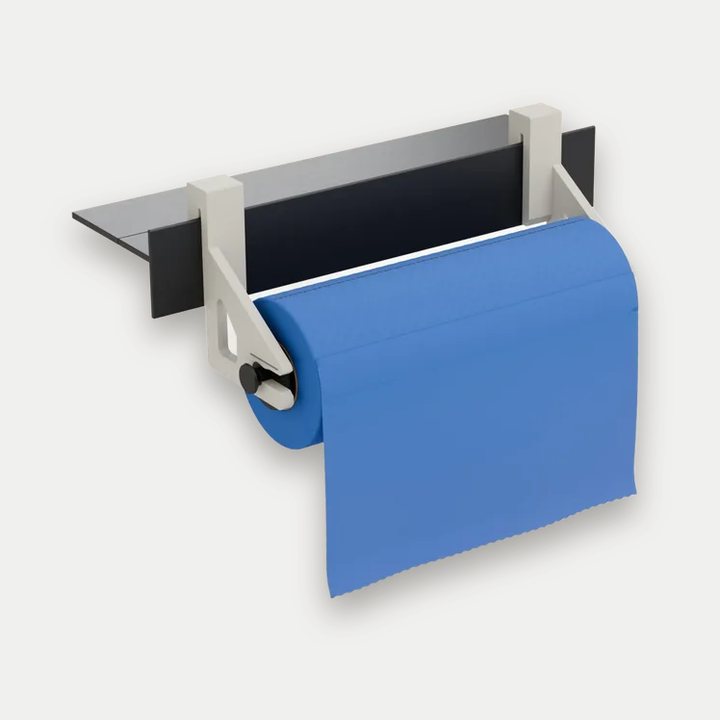
Holds a shop towel roll by its ends on your cart.
Not test-printed. Fit and strength are unverified.
Product ID: oc-l-towel-arm
Not test-printed. Fit and strength are unverified.
Default files — direct ZIP
Shop towel roll holder · Standard · Magliner / Backstage
Choose this labelled default only if it is the version you want. Other choices use the selectors above.
Not test-printed. No physical test is recorded for this file revision. Fit and strength are unverified. Product ID: oc-l-towel-arm · Release: files-5aea3d8994
- Required: Cart lip fit tester · about 15 min. Push it onto the shelf edge. It fits if it slides on by hand and does not fall off when you tug it. A little play is fine.
Print one left arm and one right arm: the plain ones, or the ones with "hood" in the name for a rain hood. Then print two end caps of the size that fits your roll: cap38 for a 1.5 in or 1.6 in core (37.5-41 mm across the inside), cap44 for a 1.75 in core (41.5-46 mm). Measure across the inside of the core with a ruler.
Hardware: 2 × thumb screw (M5 × 20) and 2 × heat-set insert (M5), one of each per arm. Needed here, not optional: the right arm slides along the lip to fit your roll, and the screw holds it there. The screw only works on a shelf edge at least 16 mm tall (measure from the shelf top up to the top of the edge)
Download this default ZIPWhat's in the zip
Default selection: Shop towel roll holder · Standard · Magliner / Backstage
READ_ME_FIRST.txt
LICENSE.txt
2_print/oc-l-towel-arm__magliner__clip-oc-l-towel-arm.stl
2_print/oc-l-towel-arm__magliner__clip-oc-r-towel-arm.stl
2_print/oc-l-towel-arm__magliner__clip-oc-l-towel-arm-hood.stl
2_print/oc-l-towel-arm__magliner__clip-oc-r-towel-arm-hood.stl
2_print/oc-l-towel-arm__magliner__clip-oc-cap38-towel-end-cap-1.stl
2_print/oc-l-towel-arm__magliner__clip-oc-cap44-towel-end-cap-1.stl
1_print_first/fit-tester__cart-lip__fit-test-slice.stl
3_hardware.txt
How it's made
Spills, wet cases and greasy grip hands: a roll on the shelf rolls off or gets dirty. This holder hangs a blue shop-towel or paper-towel roll along the cart side, below the shelf top, out of the dirt.
Parts: print a left and a right arm (plain or with the rain hood) and two end caps of the size that fits your core.
- Arms: each drops onto the lip on its own mount block and locks with an M5 thumb screw (required here, see below).
- End caps, two sizes: cap38 for 1.5 in and 1.6 in cores (37.5-41 mm inside), cap44 for 1.75 in cores (41.5-46 mm). Scott shop towels come on 1.5 in or 1.75 in cores; measure yours across the inside with a ruler.
- Each cap is a slotted collet: eight 1.6 mm fingers with a grip band near the tip flex in as you push the cap into the core, and the core then stops on a 45 degree shoulder. So the cap always sits at the same depth (within about 2 mm), however hard you push it.
- No loose rod to bounce out.
Setting up (once): push a cap into each end of the roll. Drop the left arm onto the lip and tighten its thumb screw. Hang the roll's left stub in the left arm's hook, slide the right arm along the lip until its hook takes the right stub with the cap discs just touching the arm plates, then tighten the right thumb screw. For a 250-280 mm roll the arms' outer faces end up about 276-314 mm apart.
Changing the roll: hold the roll level, line the two cap stubs up with the arms' front openings and push it toward the cart. The stubs click past a sprung detent (0.7 mm) and then drop 4.5 mm into a closed seat. To take it off, lift slightly and pull it out past the detent. Move the caps to the new roll.
Why it stays on: the roll's weight sits in a closed hook. A bump that lifts the roll only pushes the stub up against the detent. To escape, it would have to rise 4.5 mm, move 15 mm straight out from the cart past the detent, then clear the arm. The arms are separate clips, so the thumb screws are what keep them from walking apart along the lip on a rough push. With both tightened, the spacing cannot change and the caps cannot pull out of the core.
Light drag: each stub rests in a 50 degree V seat, so the roll's own weight presses it onto two flanks. The V seat adds a little drag, most noticeable on a full roll (it fades as the roll gets lighter). That keeps a full roll from free-spinning on a bump. Tear a sheet with a quick downward snap; a slow pull just unrolls more paper. Not yet tested with a real roll, so check the drag on your first print.
Rain hood (optional): the hood arms carry a curved hood half each, 178 mm long. The right half is slightly larger, so the two halves telescope over each other and overlap for any spacing between the arms' outer faces from about 190 to 336 mm, which covers every roll the caps fit. The hood keeps rain off the top and back of the roll. Its front edge is set back so the roll still slides in.
Takes rolls up to 130 mm across (blue shop-towel rolls and standard paper towels; jumbo paper towel rolls over 130 mm will not fit), about 279 mm long. A full 130 mm roll clears the arm's own mount block by 3 mm while you load it.
Cart facts
- Arms stick out 102 mm from the cart side (hood arms 122 mm). A full 130 mm roll sticks out 134 mm
- Arms hang 90 mm below the shelf top; a full 130 mm roll hangs 140 mm below the shelf top
- Needs 45 mm of flat cart side below the lip at each arm (30 mm wide). Anything lower is set 2.5 mm back from the cart
- Nothing of the arm sits higher than the 42 mm mount block (the hood top is about 15 mm above deck level, outside the cart)
Retention: held by gravity unless you fit the M5 thumb screw. For this holder the thumb screw is required on both arms, because it is the only thing that locks the spacing between the two separate arms. Press a short M5 heat-set insert (6.4 mm hole, 9 deep) into the shelf top-side face of each arm's inner flange (one per arm), and use a nylon-tipped M5 thumb screw to clamp the lip. Check first that your lip is at least 16 mm tall.